The Best Squats You Aren’t Using
 We have written quite a bit about squats, not just because they seem to be foundational to every fitness program, but also that we look at squats a bit different. In DVRT we don’t talk about how to isolate your quads more because that’s not really what squats are all about. In fact, we could make the argument that thinking in that way of using this or that muscle really misses the boat on why squats are so effective. What do I mean?
 This review paper on ACL injury rehab gives us a good explanation…
“The hip, knee, and ankle joints when taken together, comprise the lower extremity kinetic chain. Kinetic chain exercises like the squat recruit all 3 links in unison while exercises such as seated quadriceps extensions isolate one link of the chain. Biomechanical assessment with force diagrams reveals that ACL strain is reduced during kinetic chain exercise by virtue of the axial orientation of the applied load and muscular co-contraction.
Additionally, kinetic chain exercise through recruitment of all hip, knee, and ankle extensors in synchrony takes advantage of specificity of training principles. More importantly, however, it is the only way to reproduce the concurrent shift of ‘antagonistic’ biarticular muscle groups that occurs during simultaneous hip, knee, and ankle extension. Incoordination of the concurrent shift fostered by exercising each muscle group in isolation may ultimately hamper complete recovery.”-Palmitier, et al, “Kinetic Chain Exercise in Knee Rehabilitation”
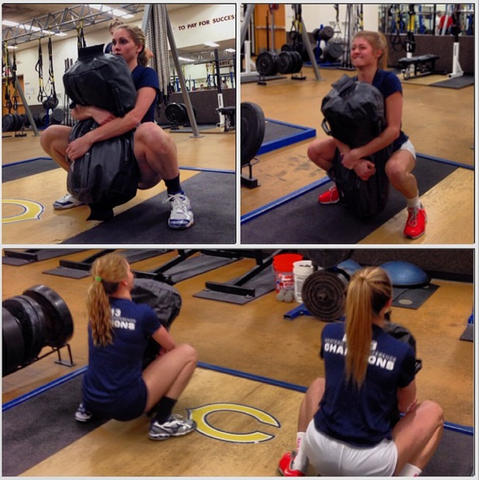
Okay, if that was a bit too sciency for you, don’t feel bad. It was a super geeky way of saying that the point of squats is to teach the lower body to work efficiently together. Trying to emphasize one muscle or another for one doesn’t really matter ALL that much in building actual muscle. Additionally, the way we build strength and resilience is by teaching the body to work as it is designed to function. When it comes to squats that means a strong, deep position squat with good posture. How do we do that in DVRT? Coach, Johnny Rhodes does a good job of showing some of our DVRT progressions of how we build strength and mobility with manipulating how we hold the Ultimate Sandbag.
This review paper on ACL injury rehab gives us a good explanation…
“The hip, knee, and ankle joints when taken together, comprise the lower extremity kinetic chain. Kinetic chain exercises like the squat recruit all 3 links in unison while exercises such as seated quadriceps extensions isolate one link of the chain. Biomechanical assessment with force diagrams reveals that ACL strain is reduced during kinetic chain exercise by virtue of the axial orientation of the applied load and muscular co-contraction.
Additionally, kinetic chain exercise through recruitment of all hip, knee, and ankle extensors in synchrony takes advantage of specificity of training principles. More importantly, however, it is the only way to reproduce the concurrent shift of ‘antagonistic’ biarticular muscle groups that occurs during simultaneous hip, knee, and ankle extension. Incoordination of the concurrent shift fostered by exercising each muscle group in isolation may ultimately hamper complete recovery.”-Palmitier, et al, “Kinetic Chain Exercise in Knee Rehabilitation”
Okay, if that was a bit too sciency for you, don’t feel bad. It was a super geeky way of saying that the point of squats is to teach the lower body to work efficiently together. Trying to emphasize one muscle or another for one doesn’t really matter ALL that much in building actual muscle. Additionally, the way we build strength and resilience is by teaching the body to work as it is designed to function. When it comes to squats that means a strong, deep position squat with good posture. How do we do that in DVRT? Coach, Johnny Rhodes does a good job of showing some of our DVRT progressions of how we build strength and mobility with manipulating how we hold the Ultimate Sandbag.
John shows not only progressing squats, but also how we build to more single leg squats through our Sprinter Stance. Moving to more single leg squats actually helps us build balance between the two sides and correct imbalances that often are masked in focusing too much on the bilateral position. The great thing about the Sprinter Stance is that it is actually very friendly to many people’s knees and low back issues, plus makes unilateral training more accessible to more people.
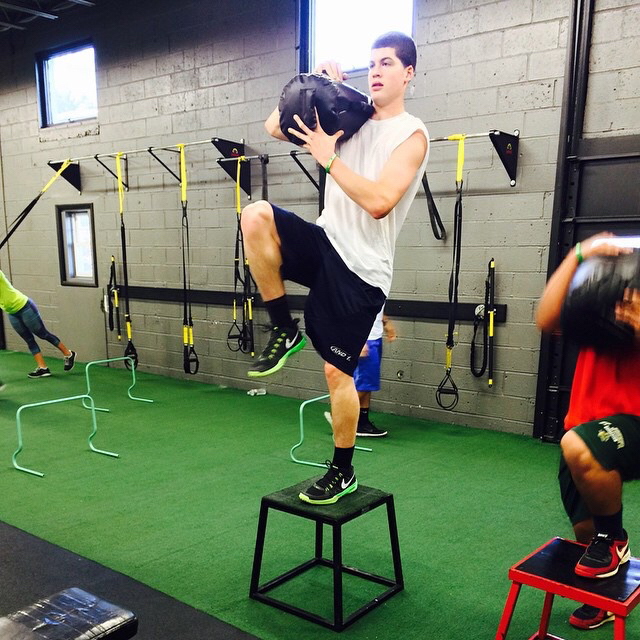 Even better is the fact with step-ups we can change the height of the step, the direction of the step, the position of the step, and we can go from the top down or bottom up, there are such great ways to build incredible leg strength as well as other powerful functional fitness qualities. My point is that squats are about quality movement and have layers to them that won’t break our backs and knees in the process. Imagine getting stronger, but moving and feeling better too. Doesn’t that sound like the point of any good training program.
Because we believe knowledge truly is power, we are offering 35% off all our Ultimate Sandbag online courses (several that get into power training from different aspects) with code “education” HERE
Even better is the fact with step-ups we can change the height of the step, the direction of the step, the position of the step, and we can go from the top down or bottom up, there are such great ways to build incredible leg strength as well as other powerful functional fitness qualities. My point is that squats are about quality movement and have layers to them that won’t break our backs and knees in the process. Imagine getting stronger, but moving and feeling better too. Doesn’t that sound like the point of any good training program.
Because we believe knowledge truly is power, we are offering 35% off all our Ultimate Sandbag online courses (several that get into power training from different aspects) with code “education” HERE
Newsletter
Sign-up to our newsletter for free, regular training tips.